Real. Inclusive. Human.
We think too much of the language people use in and about social care reveals and shapes attitudes and ways of working that prevent all of us from living Gloriously Ordinary Lives. We believe that the language of social care should be ordinary. Everyday words about everyday life. And we think our language should be glorious. Wonderful words about flourishing lives.
Gloriously Ordinary Language is a growing movement for change.
It's not about policing language, banning words or creating a list of words to avoid and words to use instead.
It's not really even just about language. It's about getting to the heart of our humanity and keeping everything real, inclusive and human.
‘Caring for the elderly and the vulnerable’
‘Looking after those with needs’
‘Delivering personal care to a range of service users’
‘Dealing with complex cases’
This is the language we hear, read and use about social care. It’s everywhere. On our radios and TV screens and in our newspapers. In our council offices and care and support organisations. In the letters we send or receive and the conversations we have.
We think that social care is about all of us, not them and us.

Test Two for Gloriously Ordinary Lives challenges us to consider, would I use that language in my kitchen with my family or at the cafe or pub with my mates?
Think about the words you use to describe people, where people live, the way people communicate, and the things people do. If those words aren't words you'd use with family and friends, they are probably words that get in the way of people living Gloriously Ordinary Lives.
Are you working in or with an organisation where most of the language people use isn’t what you would use in the kitchen with your family, or in the café or pub with your mates?
Do you feel, like we do, that this is not OK?
The Gloriously Ordinary Language programme is an invitation to think and act radically differently. Through a mix of discussion, exercises and practical work, we'll expose the dominant language and ideas in and about social care and how these trap us into ways of being and working with each other that are less than human. Then we’ll work together to help you reimagine the purpose of social care and your organisation, rehumanise language, and reconnect with what matters most - making sure that all of us get to live Gloriously Ordinary Lives.
Do you find yourself talking or writing about people’s 'challenging behaviour’ and ‘complex needs’, their ‘activities of daily living’ and whether or not they can ‘access the community’?
Have you been told to say, ‘people we support’ rather than 'service user'?
Are you spending your days ‘signposting' and ‘assessing' ‘cases' before you ‘place' them?
Maybe you use this language because you were taught it or your colleagues use it. Maybe it feels ‘professional’. Maybe it's because that’s what your forms say, or because your manager or the panel or your commissioners or CQC expect it.
This lovely graphic was created for us by Dr Pen Mendonça. It shows a selection of the words that make us go hmmm… because they reveal and shape attitudes and ways of working that prevent people from living Gloriously Ordinary Lives. It also shows some of the real, inclusive and human words that we often don’t hear or use enough.
Words that make us go hmmm…
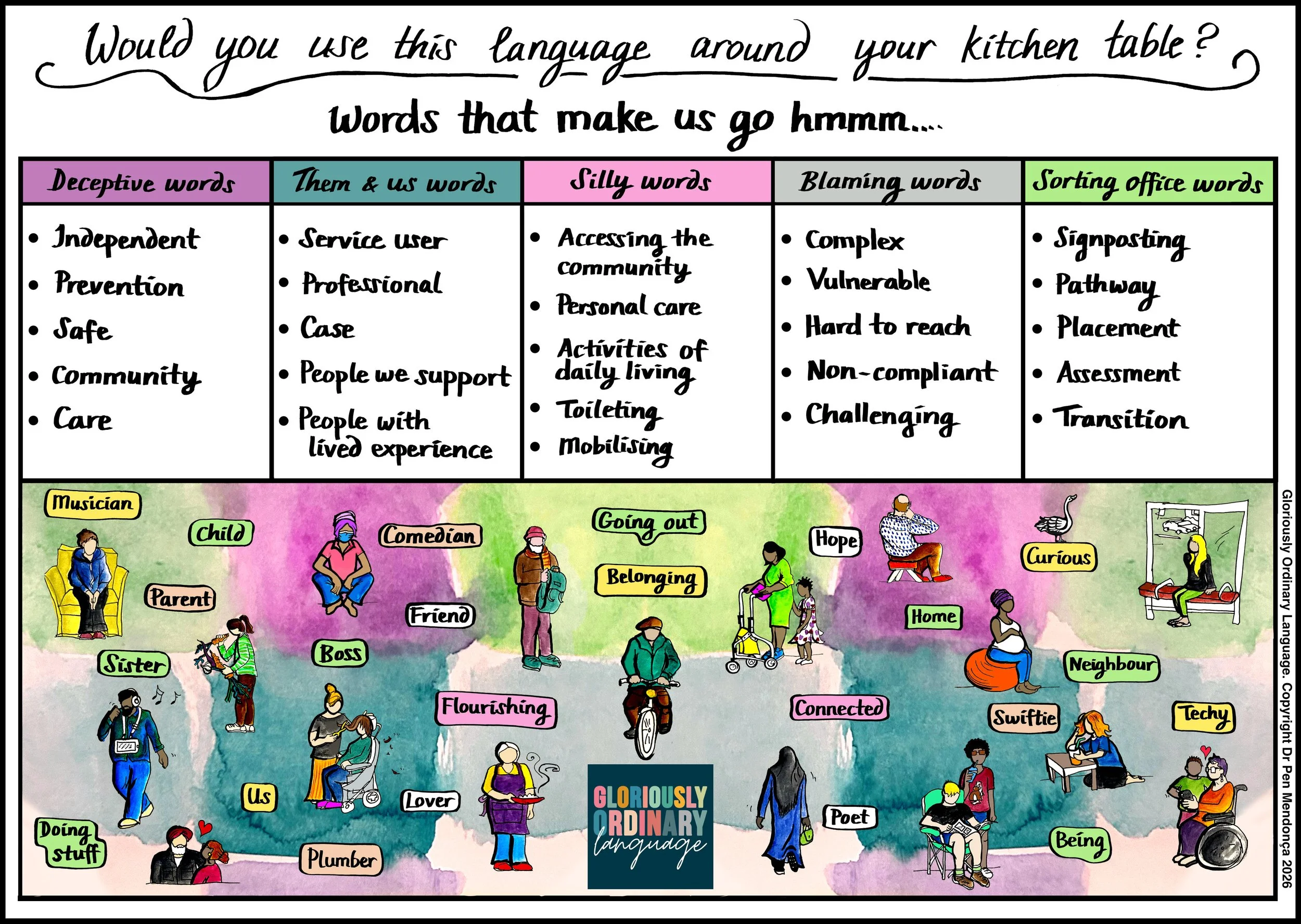
Have a listen to Tricia and Bryony talking about the graphic - watch the video below.